Jumble Solver - Unscramble Letters Into Words
A jumble solver takes scrambled letters and lists the words they can make. Enter your letters, choose whether every letter must be used, and the tool shows the dictionary words that match. It does not solve the cartoon punchline of a newspaper Jumble, but it gets you past the scrambled words.
Jumble solver tool
Up to 12 characters. Use ? for an unknown letter (up to 3).
0 words found
How do I use the jumble solver?
Type the scrambled letters exactly as printed, choose a mode, and press Solve. For a newspaper Jumble, use exact match.
- Enter your letters. If the puzzle shows ELPPA, type E-L-P-P-A. You can enter up to 12 characters, in capitals or lowercase.
- Choose exact match or shorter words. Shorter words is selected by default. For a newspaper Jumble, switch to exact match.
- Type ? for an unknown letter. An underscore (_) works too, and you can use up to 3.
- Press Solve (or Enter). After the results appear, you can narrow the list by word length, by a starting letter or by an ending letter.
- Read the list. The longest words come first, and everyday words appear before rare ones within each length. Best match shows the longest everyday word; it is a suggestion, not the puzzle's answer. Click a word to copy it, or press Copy results to copy the whole list. Long lists show 60 words at a time with a Show more button.
- Press Clear to start another puzzle. Shuffle letters mixes up the letters in the box if you want a fresh look at them.
What is a jumble solver?
A jumble solver turns a set of scrambled letters into words. "Jumble word solver" and "word jumble solver" are two names for the same kind of tool, and it is also called a word unscrambler or, loosely, an anagram solver.
The names overlap, so what matters is whether the tool must use every letter. An anagram starts with a real word (LISTEN becomes SILENT). A word jumble starts with a random-looking mix and asks you to find the word inside. A solver handles both the same way.
| Tool | What it does |
|---|---|
| Jumble solver | Unscrambles puzzle words, usually using all letters |
| Anagram solver | Finds words or phrases made by rearranging letters |
| Word unscrambler | Finds full-length and shorter words from a letter set |
| Wordle solver | Narrows guesses using green, yellow and gray feedback |
A Wordle solver works differently. It does not rearrange letters; it filters five-letter words using feedback from earlier guesses. If that is what you need, try our Wordle Solver.
How do you solve the daily Jumble?
Unscramble each word, find the marked letters in the solved words, collect them, and rearrange them to fit the caption and the number of blanks. A solver helps with the words. The final phrase needs a person, because it depends on the cartoon and the pun.
- Read all the scrambled words first and start with the easiest.
- Unscramble each word using every letter once.
- Find the circled (marked) letters in each solved word.
- Copy those letters together into one group.
- Read the cartoon and the caption. The blanks show how many letters and words the answer needs.
- Rearrange the collected letters until they fit the caption.
The same letters can often form more than one real word, and only one fits the joke. That is why the last step is the hardest.
Worked example (invented practice puzzle)
This practice puzzle was made up for this page. It is not an official Jumble. It is also simpler than a real daily puzzle (four five-letter words instead of two five and two six), and the marked letters below are invented for the example. A real puzzle shows its own marked letters in its layout.
Scrambled words: REGIT, ABDER, ELPPA, CHEBA
Caption: "The hungry fox said it was time to ___ a bite." (4 letters)
- Unscramble: REGIT is TIGER, ABDER is BREAD, ELPPA is APPLE and CHEBA is BEACH. ABDER also fits BEARD, BARED and DEBAR, so the solver lists several words for it. This practice puzzle uses BREAD.
- Marked letters (invented for this example): the 3rd letter of TIGER (G), the 2nd of BREAD (R), the 1st of APPLE (A) and the 1st of BEACH (B).
- Collect G, R, A, B and rearrange them to fit the caption: GRAB.
"Time to grab a bite" fits the caption and the four blanks. Enter any of the scrambled words into the solver above to check the unscrambling.
What is the Jumble puzzle?
Jumble is a newspaper word puzzle made of scrambled words, a cartoon and a caption with blanks. Martin Naydel, a comic book artist, created it in 1954, and it first appeared as "Scramble." The Jumble name is owned by Tribune Content Agency.
- The standard daily version has four scrambled words: two with five letters and two with six.
- A weekly kids' version uses one three-letter word and three four-letter words.
- The brand has other formats, such as Jumble Crosswords and Jumble BrainBusters, so follow the instructions printed with your puzzle.
- Henri Arnold and Bob Lee later took over the feature. Today, David L. Hoyt and Jeff Knurek create it for Tribune Content Agency.
- The puzzle appears in hundreds of newspapers in the United States and abroad.
This site is independent and is not affiliated with or endorsed by Jumble or its owners.
Exact match vs shorter words
Exact match returns only words that use every letter you entered, once each. Shorter words also returns words that use some of the letters. For a newspaper Jumble, use exact match. For games where partial words count, such as a Scrabble rack, use shorter words.
Example with the letters ELVI:
- Exact match: EVIL, LIVE, VEIL, VILE
- Shorter words: also LIE and VIE, plus a few other short entries such as EL, LEI, LEV and LI. On the current word list, ELVI returns 10 words in this mode and 4 in exact mode.
Repeated letters matter. APPLE has A=1, P=2, L=1, E=1. ELPPA has the same counts, so it matches. A scramble with three Ps, such as LPPPE, would not.
How does a jumble solver work?
A solver does not need to try every arrangement of your letters. It compares them with a prepared word list, either by counting letters or by sorting them into a signature. The exact method depends on how the tool is built.
Six different letters can be arranged in 720 orders, and when letters repeat the number of distinct arrangements is smaller. Either way, trying every order for every input would be wasteful.
Method 1: count the letters. The solver counts how often each letter appears in your input and in each dictionary word. If the counts match, it is a match.
Method 2: sort the letters. Sort each word's letters alphabetically to make a signature. Words with the same signature are anagrams.
| Word | Sorted signature |
|---|---|
| LISTEN | EILNST |
| SILENT | EILNST |
| TINSEL | EILNST |
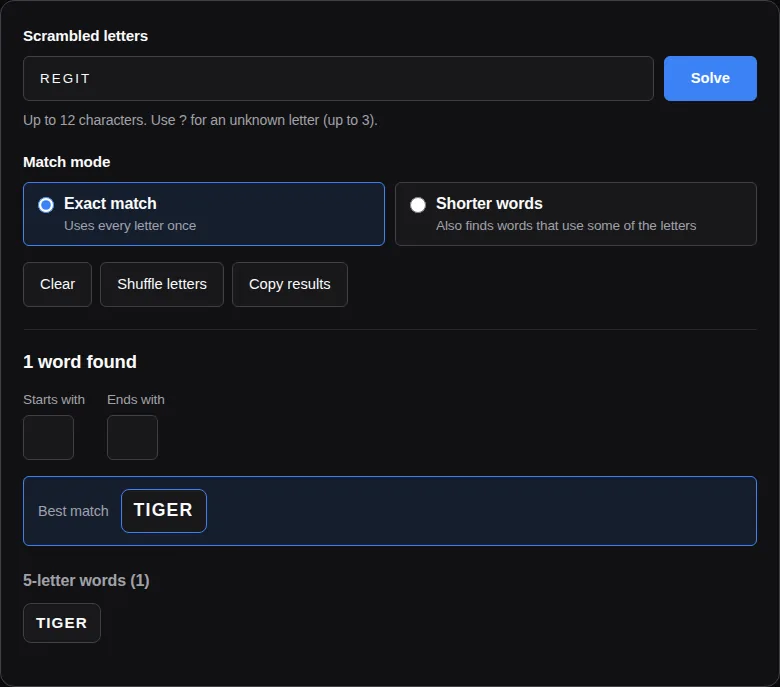
REGIT sorts to EGIRT, and so does TIGER, so one is an anagram of the other. When the dictionary is prepared in advance, the solver only looks up the signature.
Blank tiles: a ? stands for an unknown letter. A word matches if the only letters it needs beyond yours are covered by the blanks.
Our solver uses method 1, counting letters, against a built-in list of 187,913 English words. It checks the whole list on every search, which takes a fraction of a second. Different solvers use different word lists, so results can differ between sites.
How can I unscramble words by hand?
These habits work with or without a tool.
- Look for prefixes (UN-, RE-, DE-, DIS-, PRE-, NON-, ANTI-, INTER-, SEMI-) and suffixes (-ING, -ED, -ES, -ER, -EST, -LY, -TION, -MENT, -NESS, -ABLE). Pull them out first.
- Watch for letter pairs that stay together: TH, CH, SH, PH, ST, CK, and doubles such as LL and SS. A Q is almost always followed by U.
- Write the letters down, ideally in a circle, so the scrambled order does not look like a real word.
- Separate vowels and consonants, and try different first letters.
- Say combinations out loud, skip a hard word and come back to it.
- Think about the theme. The cartoon can hint at it.
Why are results missing or showing several words?
Several answers are normal because different words can use the same letters. EVIL, LIVE, VEIL and VILE all share the same four. Use the clue, the marked letters and the context to choose.
If nothing appears, check these in order:
- Did you mistype a letter or leave one out?
- Is a filter (word length, starting letter or ending letter) removing the right word?
- Are you in exact-match mode? Try shorter words.
- Is the answer a name, a proper noun or a foreign word? These are often missing from an English word list. A few names do appear, but the list is not built for them.
- Is the word rare, old or technical? It may be missing from our word list.
- Did you enter letters from different words together? Solve one word at a time.
Can I use it for two words, today's answers or other word games?
Two or more words: not as a phrase solver. For a multi-line puzzle, solve one scrambled word at a time. With many letters, a phrase solver returns a huge number of nonsense combinations, and choosing the real phrase needs a person who has seen the clue.
Today's answers: no. This tool unscrambles the letters you enter. It does not publish the daily puzzle or its answers. For the puzzle itself, see jumble.com or your newspaper.
Scrabble, Words with Friends, Text Twist: use shorter words and ? for a blank tile. The tool generates candidate words from its dictionary, not guaranteed legal plays. Each game has its own word list, so check a word in the game's own dictionary. It does not score tiles.
Crosswords: the solver does not read clues or letter patterns. It helps only if the clue is itself a scramble.
Teachers and parents: scramble spelling or vocabulary words and have students put them back in order. They try first, then check with the tool. Names and unusual proper nouns may not be found.
Limitations and privacy
A solver finds words that fit the letters. It cannot know which word the puzzle author intended, cannot read the cartoon or solve the pun, and cannot guarantee a result for names, foreign words or rare terms.
Privacy: the solver runs in your browser. The letters you type are matched against the word list that loads with the page, and the tool does not send them to our server or save them. Like the rest of this site, the page uses Google Analytics and Google AdSense, as described in our Privacy Policy.
Test notes
These checks were run on October 15, 2026 against the current word list. REGIT returned TIGER as its only exact match. ELPPA returned APPLE, along with the rarer words APPEL and PEPLA, and a three-P scramble such as LPPPE returned no exact match, so repeated letters are counted. ELVI returned EVIL, LIVE, VEIL and VILE in exact mode and 10 words in shorter-words mode. ABDER returned six words, including BEARD, BARED, BREAD and DEBAR, which is why the worked example above mentions more than one fit. An impossible input such as QQQQQ shows a message instead of an empty page. RETW? in exact mode returned 13 words, including WATER, TOWER and THREW. Characters other than letters and ? are removed as you type, and the box is limited to 12 characters.
Written by James Martin. Last updated: October 15, 2026. Word list: built-in English word list (187,913 words).
Frequently asked questions
Is a jumble word solver the same as a word jumble solver?
Yes. Both names describe the same kind of tool.
Is it free?
Yes. The solver is free to use and needs no sign-up. The only limit is 12 characters per search. The site is supported by ads.
Does it use all the letters?
In a traditional Jumble each answer uses every letter once, so use exact match. Shorter words is for games where partial words count.
Can it solve the final cartoon answer?
It helps with the individual words, which give you the marked letters. The final phrase depends on the cartoon and caption, so you choose the arrangement that fits.
Can I use it for the 5-letter and 6-letter words in the daily Jumble?
Yes. Enter each word on its own in exact-match mode.
How many letters can I enter?
Up to 12 characters per search. Up to 3 of them can be blank tiles (?).
Does it work on my phone?
The layout adapts to small screens, and the letter box opens your phone's normal keyboard. It was checked in a 390-pixel-wide mobile view.
Is it always right?
It reliably matches letters to its word list. It cannot guarantee the answer the puzzle author intended.
Related tools
- Narrow Wordle guesses with green, yellow and gray feedback: our Wordle Solver
- Today's Wordle hints and answer: Wordle Today