If you just downloaded Block Blast and your games keep ending quickly, or if you have been playing casually for a while but feel stuck at the same score range, this guide is written for you. Block Blast looks simple but has several non-obvious mechanics that completely change how you should approach each turn. Understanding them early saves a lot of frustration and gets you to consistent mid-game scores much faster than learning purely through trial and error.
The Three Things That Make Block Blast Different
If you have ever played Tetris or other falling-block puzzle games, your existing instincts might actually work against you in Block Blast. Here are the three most important ways Block Blast plays differently:
No Rotation
Pieces cannot be rotated. The orientation shown is the orientation you use. This means there is no way to "fix" a piece that looks like it would fit if only it were turned 90 degrees. What you see is what you get, every time. This makes piece matching more about board preparation than piece manipulation.
Both Rows and Columns Clear
In Tetris, only horizontal rows clear. In Block Blast, both horizontal rows and vertical columns clear when they are completely filled. This doubles your clearing options but also means you need to think in two dimensions simultaneously a skill that takes deliberate practice to develop.
Three Pieces at Once, in Any Order
You see three pieces at once and can place them in any order you choose. This is not just a cosmetic difference the order you place them significantly affects what board state you end up with. A set of three pieces that seems impossible to place well in one order might work cleanly in a different order. Always evaluate all three before placing any.
The Basic Rules: What You Actually Need to Know
Before strategy, the mechanics:
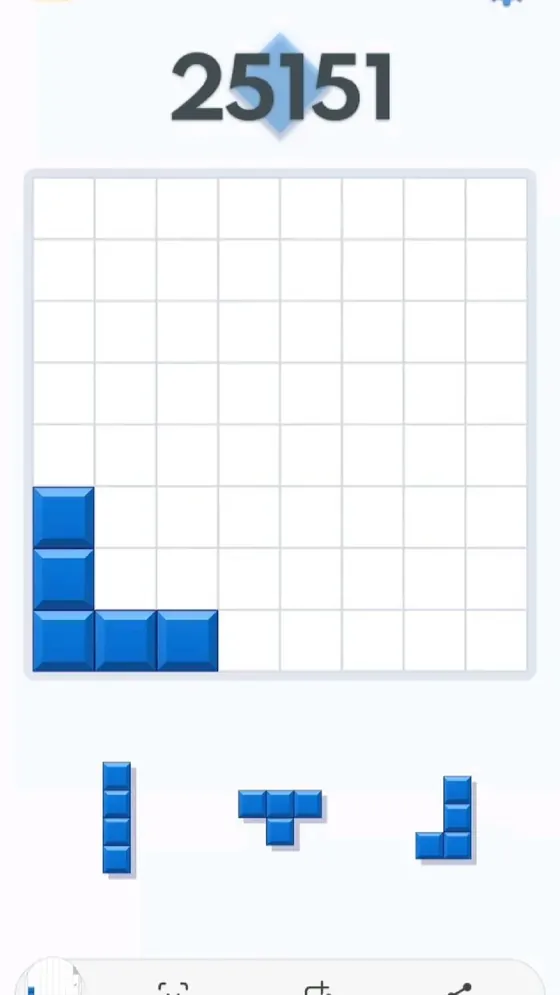
- The board is 8x8 (64 cells total)
- You receive three pieces at a time and must place all three before the next set arrives
- A row clears when all 8 cells in a horizontal row are filled
- A column clears when all 8 cells in a vertical column are filled
- Cleared cells become empty nothing falls or shifts, everything else stays in place
- The game ends when none of the three available pieces can be placed anywhere on the board
- There is no time limit take as long as you need
That last point is more important than it sounds. Block Blast is a pure strategy game. Rushing is always counterproductive. Every lost game is a result of a placement decision, not a reaction speed failure.
Your First 10 Games: What to Focus On
Do not try to apply everything at once. In your first ten games, focus only on these two things:
1. Keep the Board Flat
After every placement, look at the board surface and ask: is it more even or less even than it was before? Tall columns and deep valleys make future placements much harder. Your goal in the early games is simply to develop a feel for what a "healthy" board looks like roughly flat, no isolated pockets, no columns significantly taller than others.
You will not always achieve this, but the habit of noticing when the board gets uneven is the foundation for every other skill in the game.
2. Look at All Three Pieces Before Placing Any
Before touching anything, look at all three pieces and roughly plan where each one could go. You do not need a perfect plan just make sure you are not placing piece one in a way that eliminates the only valid position for piece three. This one habit alone will extend your average game length significantly in the first few sessions.
The Five Biggest Beginner Mistakes
Mistake 1: Filling Corners Too Early
Corners are the most dangerous areas of the board for beginners. Once a corner is partially filled with a structure that does not form a complete row or column, it becomes very hard to clear. Large pieces especially cannot fit into corner areas once they are partially occupied with mismatched shapes. Treat corners as a last resort fill them only when a piece genuinely completes a line there, not just because it fits.
Mistake 2: Chasing Clears Without Checking the Result
Beginners often see a line clear opportunity and take it without looking at what the board looks like after the clear. Sometimes taking the clear leaves behind an isolated gap, a stranded column, or a blocked corner that creates a much bigger problem two or three moves later. Before completing a clear, look at the resulting board state, not just the clear itself.
Mistake 3: Placing Pieces in the Center First
The center of the board is your most flexible space. Pieces placed in the center on early turns quickly reduce your options for accommodating the wider variety of shapes that come later. In the early game, prefer building along the edges and leaving the center as open working space for as long as possible.
Mistake 4: Ignoring Large Pieces Until They Arrive
Large pieces especially 3x3 squares and 2x3 rectangles appear regularly in Block Blast. If you have been filling the board without leaving organised open areas, the arrival of a large piece will catch you without any valid placement. Think of large pieces as inevitable guests: prepare the room before they arrive rather than scrambling when they do.
Mistake 5: Panicking on a Messy Board
When the board gets messy, beginners often make impulsive placements that make things worse. The correct response to a messy board is to slow down and switch into cleanup mode: stop trying to score and focus entirely on filling the most awkward gaps and flattening the surface. Even two or three careful placements with no clears can dramatically improve a board that looked unmanageable.
Building the Right Habits from Game One
Think Out Loud (or in Your Head)
A useful practice technique is to briefly state your reason for each placement before making it. "I am placing this here because it fills the gap in row 5 and keeps column 3 open for the L-piece." If you cannot articulate a reason, that is a signal to think more before placing. This sounds slow at first but quickly becomes fast as the reasoning becomes instinctive.
Pause Before Every Placement
There is no time pressure in Block Blast. There is never a reason to place a piece immediately. Make it a rule in your first twenty sessions to always look at the full board and all three pieces before placing anything. The pause pays for itself many times over in extended game lengths and higher scores.
Use the Solver as a Teacher, Not a Crutch
When you get stuck or the game ends, use the Block Blast Solver to reconstruct the difficult board state and see what optimal play looked like. Specifically, look for: where did the recommended placement differ from what you were considering, and why does the solver's version leave a better board state? This comparison is worth more than replaying the game blind several more times.
Moving from Beginner to Intermediate
Once your games consistently last 50+ moves and you understand why they end when they do, you are ready for the next level of skill. The intermediate skill set has three components:
Combo Awareness
Start actively trying to clear lines on consecutive placements rather than just when a clear is convenient. Keep a near-complete row alive at all times as a reliable clear anchor. Read the full Block Blast Combos guide once you are comfortable with the basics.
Multi-Line Clear Setup
Look for opportunities where a single piece can clear both a row and a column simultaneously. These double clears earn significantly more than two separate clears and are the key to pushing past the 10,000-point threshold consistently.
Piece Shape Mastery
Learn the characteristics of every piece type which are easy to place anywhere, which require specific board conditions, and how to handle difficult combinations. The Block Blast Piece Shapes guide covers all of this in detail.
Beginner Quick Reference
- Have I looked at all three pieces?
- Does this placement make the board more flat or less flat?
- Does it block any valid position for the other two pieces?
- Does it contribute to any line clear row or column?
- What does the board look like after this placement?
You do not need to go through this checklist consciously for every single move with practice it happens automatically. But drilling these questions in your first sessions builds the evaluation instinct that makes later improvement much faster.
What to Read Next
Now that you have the foundation, the most useful next reads are:
- Block Blast Strategy Guide deeper placement principles for intermediate and advanced play
- Block Blast Piece Shapes Guide how to handle every piece type
- Block Blast Combos Guide how to multiply your score through chain clears
- Block Blast High Scores Guide understanding the scoring system and score benchmarks
And whenever you encounter a board you cannot figure out, the Block Blast Solver is there to show you what optimal play looks like on that specific board state.